
Evergreens – from Tannenbaum to Frogfruit
By Dolly Dearner
Christmas is almost here – time for millions of evergreen trees to be brought home and decorated. Trees that fall into the categories of pine, spruce, or fir, typically with hard seed-bearing cones and spiky needles often come to mind when we think of evergreens. But the world of evergreens goes far beyond trees with needles and cones, and in fact is not limited to trees at all.
One common evergreen in Oklahoma City is the magnolia, a popular tree that lives long and grows tall. It features large, fragrant white blossoms in the spring and shiny oval green leaves throughout the year (some varieties of magnolia are deciduous).
The Juniper genus comprises shrubs and trees, including the widespread (though not always beloved) eastern redcedar. From large arborvitae to low-lying ground cover, this genus provides an array of useful and popular specimens.
Holly trees are a favorite evergreen, though some varieties (possumhaw, Carolina holly) are deciduous. American holly has the classic spiky leaves and clusters of red berries. Yaupon holly has smaller oval-shaped leaves and red berries and is well known as the only native plant source of caffeine in North America. It can be grown as a shrub or a small tree.
Bay leaves from evergreen bay trees are a familiar ingredient in soups, stews, sauces, and marinades (they are not consumed directly but are added as a flavoring agent). Bay leaves are also used to make decorative wreaths.
Many ground covers are evergreen or semi-evergreen, such as blue rug juniper, creeping juniper, English ivy, and liriope (to name only a few). The Oklahoma native frogfruit, which is semi-evergreen here but fully evergreen in warmer climates, creates an attractive ground cover without being invasive. You can see frogfruit in some of the beds at Will Rogers Park. A few herbs, such as creeping thyme rosemary, sage, and lavender are also evergreen.
Mistletoe is well known as a parasitic evergreen plant that lives on trees and may eventually kill them. Despite its unsavory reputation, it has long been popular for Christmas decorations. The plant is toxic if ingested, but no sensible person would eat mistletoe. It is usually hung high enough for two adults to stand under, well out of reach of children and pets.
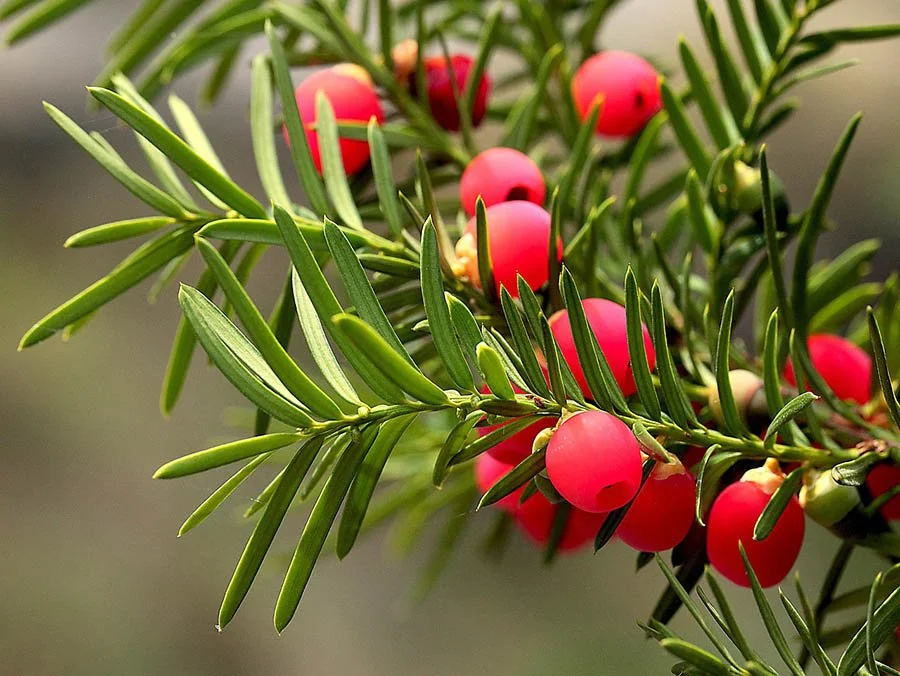
Yew trees have long lives but paradoxically are associated with death in folklore and tradition. Yew branches were briefly used in the 18th and 19th centuries as Christmas decorations. They are no longer popular as Christmas trees, perhaps because of their association with death and because the entire tree is toxic.
After deciduous trees have displayed their fall colors, lost their leaves, and gone to sleep for the winter, evergreens color the winter landscape reminding us that life goes on.